
I receive many messages from people who say, “Hi! I want to write a book. How do I get started?”
They often add a fascinating detail, for example, “Hi, I want to write a book like Tolkien. How do I get started?’ Or they might say, ‘Hi, I want to write a book like Sally Rooney. How do I get started?” Or perhaps they’ll say, “Hi, I want to write a book about werewolves and zombies. How do I get started?”
I always reply with just one word: Why?
What is your reason to write?

What is your reason to write?
I belong to a generation that was frequently pushed into creative writing, and that push usually took two forms. The first, and most unpleasant of the two, involved writing thank-you notes to relatives for gifts we didn’t want: “Dear Auntie, thank you for the nice socks you sent me. They are a bit large, but Mum says I’ll grow into them. I hope you have a nice summer. Mine was very nice. We had lots of fun. Thank you for the nice present, your nephew, Neil.”
The second type of coerced creative writing experience that we endured in the 1960s was the “one-sheet essay.” The usual scenario for this experience involved a teacher writing a prompt on a board, perhaps something like: “What I did in the summer holidays…” The class would be given an hour to fill a blank page with their thoughts and fantasies on the subject. Typically, I couldn’t remember what I’d done on my summer holiday, and even if I could remember, it wouldn’t have filled an entire sheet of paper!
When people tell me, “I want to write a book…” I feel unclear about the reasoning behind their aspiration. I’m fuzzy about what they’re telling me, because a person needs a reason to write…
However, in both those vintage situations (above) I had motivation for writing. My motivation in both cases was to avoid punishment! That’s why, when people say, “I want to write a book…” I feel unclear about the reasoning behind their aspiration. I’m fuzzy about what they’re telling me, because a person needs a reason to write. My ‘reason to write’ in my 1960s schooldays stemmed from my fear of punishment. I’ll admit that a sense of guilt also accompanied my action, but anxiety was the main driver for my creative writing.
Oh, and let me be clear, I’ve been talking about jotting down some spare thoughts on a blank page. And the piece of writing I’ve been talking about was intended for one specific reader, an aunt or a teacher. I wasn’t speaking about filling an entire book with fresh words, then launching those words to millions of readers! Crafting a book that has been filled with novel thoughts and underivative fantasies will demand a motivational purpose that must be as broad and profound as an ocean.

What is your reason to write?
Your answer to my question should ideally be presented like this:
- to get emotions off my chest
- to freely investigate and understand my thoughts, as I see fit
- to narrate a tale that I think must be told
- to make things clearer for others, things that I’ve personally found confusing
- to pass on what I know and what I’ve learnt through experience
- to share my views and perspectives
But it’s okay if your reason to write is because you’re scared. Or because you’re anxious about things. Those are valid reasons.
Another valid reason will be because you’ve been assigned a task (a dissertation or a tutor-marked assignment, for example.) But you must have a reason to write.
Just wanting to write won’t carry you through. Desire won’t cut-the-mustard! A plan will fail. Even the best resolutions can’t be kept…
Just wanting to write won’t carry you through. Desire won’t cut-the-mustard! A plan will fail. Even the best resolutions can’t be kept. And a simple craving will go unsatisfied. Your reason to write should drive your writing journey, because nothing else will do. That’s why those thankyou notes and one-sheet essays were so painful to write: they were difficult because we didn’t have any passion to write them!
Having a reason to write is crucial. And you must embrace the reason in your heart… you must feel passionately about it… and must feel passionately about the reason before you embark on your writing journey.
Therefore, write down your reason now. Be sure your reason to write is kept in plain sight; because your ‘reason to write’ will get you through the most difficult days ahead.
© Neil Mach January 2026
Main image: Yannick Pulver
Neil Mach is a prolific English author known for his clean urban fantasy fiction (like his popular ‘Moondog’ series) and his historical fiction works. Neil is also a well-known public speaker, and a creativity advisor. Neil has a background as a rock journalist. He frequently shares his expertise on writing and the music business, particularly rock music history, and has written over 20 books, and he often addresses writing workshops. Since its launch in 2019, his extremely popular Myth & Magic podcast has provided enthusiasts of fantasy literature and fantasy art with over 125 hours of audio enjoyment.
How to Get a Book Started…
Ever contemplated writing a book?
Which comes first? The core idea? Or the storyline? Or the characters, perhaps?
How do you organise a project so it doesn’t go “flat in the middle” and take “forever” to complete?’
How will you maintain motivation for months on end, particularly when it feels as if the process is turning into an uphill battle?
How do professional authors ‘knock out’ two or three books a year?
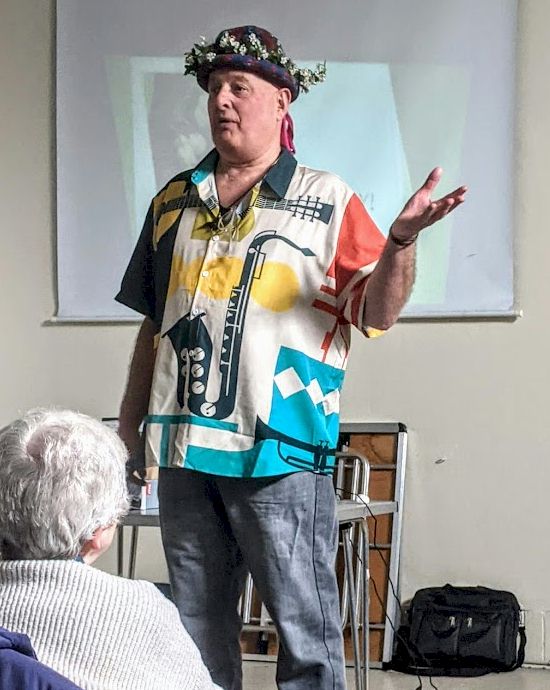
English author Neil Mach explains how to get a book started in his illustrated talk… and you can invite Neil to your book club or writing workshop to explain how to get a book project going…
With humour and instruction, Neil’s slideshow talk “How to Get a Book Started” leads an audience through the early stages of writing a book, as he explains how to tackle those important first steps that will help a book get jump-started.
You should consider inviting Neil to deliver his entertaining & educational presentation to aspiring writers, new authors, or anyone who might be interested in the creative process behind writing the most successful books.
His 45 minute slideshow presentation would be ideal for book clubs, locally run writing groups, community centres, U3A writing groups, Probus Clubs, literature circles, creative writing groups etc. Check the link here: https://speakernet.co.uk/talk/6872/how-to-get-a-book-started-how-to-write-your-first-book-with-author-neil-mach
 Max Writivity Club